
When a new office is on the cards, you’re tasked with reassessing your entire workspace strategy. It goes beyond signing off on desks and location; you need to justify decisions that directly impact cash flow, productivity and how agile your business is as it scales.
In other words, there’s a lot at stake.
So, when comparing a serviced office vs lease in the UK, it’s important to think from a growth standpoint. In this guide, Hubble explains the differences between serviced offices, managed offices, and traditional leases—including how each model affects flexible office growth, office scalability in the UK, and your broader startup workspace strategy.
Key insights:
- Serviced offices suit early-stage teams prioritising flexibility, managed offices support scaling businesses prioritising more control, and traditional FRI leases are usually only viable once headcount is stable
- Serviced and managed offices enable move-in within days or weeks with minimal upfront spend, while traditional leases take months and require significant capital
- Traditional leases can offer lower long-term occupancy costs at scale, particularly when fit-out is amortised over several years
- Flexible workspaces shift costs from Capex to Opex, helping startups preserve cash and extend runway
- Greater flexibility reduces downside risk, allowing teams to scale space up or down as headcount changes
Quick definitions:
| Serviced Offices for Startups | Managed Offices for Startups | Traditional FRI Lease |
| A fully fitted, plug-and-play office rented on a licence agreement, with utilities, business rates and services bundled into one monthly fee. | A customisable private office delivered by an operator, typically with a medium-term licence agreement and fit-out included. | A long-term lease where the tenant is solely responsible for rent, service charge, business rates, fit-out and dilapidations. |
Why workspace strategy matters for scaling UK startups
Office costs are often one of the largest fixed expenses after salaries. But for UK startups, the headline cost isn’t the only thing that matters; it’s how it’s structured and what it allows the business to do.
That’s why choosing a workspace is a strategic decision. The model you choose directly affects three things: cash flow, speed to occupancy and the ability to scale without unnecessary risk, making it way more than just a facilities task.
A traditional lease, for example, typically requires upfront investment in fit-out—along with ongoing liabilities like service charges and business rates. That can tie up capital at a stage where preserving cash and extending runway is critical.

At the same time, speed matters. Startups rarely grow in a straight line, and the ability to secure space quickly (or adapt as headcount changes) can directly affect hiring plans and overall momentum. Delays from lease negotiations, fit-out works or compliance requirements can slow teams down at the wrong time.
This is where a clear startup workspace strategy becomes important. The right setup should support how your team operates today while allowing flexible office growth and improving scalability in the UK as your business evolves.
Serviced office vs lease UK — how the three models compare
For startups evaluating serviced office vs traditional leases in the UK, the key differences show up in how quickly you can move, how much capital you need upfront and how easily you can adapt as your team changes. Here’s a quick rundown:
| Serviced Offices | Managed Offices | Leased Offices |
| Minimum commitment One month. | Minimum commitment Typically one to three years. | Minimum commitment Typically five years. |
| Cost You’ll pay a slight premium on serviced office rent compared to managed offices for flexibility, all-inclusive fees, and no fit-out costs. | Cost Managed offices have lower initial costs than leased ones. However, they can become pricier in the long run due to added premiums for flexibility, office management, and custom fit-outs. | Cost Leased spaces tend to be more expensive due to the bespoke fit-out, deposits, and legal fees, but they are often more cost-effective once established. |
| Customisation Limited: fully fitted and furnished, with minimal scope for layout or branding changes. | Customisation High: space is fitted out and customised to your requirements, including layout and branding. | Customisation Full control: typically delivered in CAT A condition, with tenants responsible for all fit-out, furnishing and infrastructure. |
| What’s included? Utilities, maintenance and the building’s wider facilities. | What’s included? Utilities, maintenance and the building’s wider facilities. | What’s included? No additional facilities are included in your rent. |
| Business rates liability Low: provider is responsible for maintenance, compliance and building operations. | Business rates liability Low to Moderate: some responsibilities may sit with the tenant depending on the agreement. | Business rates liability High: tenant is responsible for maintenance, compliance, service charges, and dilapidations. |
| Move-in time Serviced office rental allows you to move in straight away. | Move-in time The move-in time for a managed office rental takes longer, depending on the fit-out period. | Move-in time Leased transactions usually take three to six months to complete. |
| Exit flexibility High: short-term licence agreements with flexible exit terms | Exit flexibility Moderate: longer commitments, but more flexible than leases | Exit flexibility Low: limited flexibility, typically tied to break clauses or lease expiry |
| Best suited for: Early-stage/scaling teams prioritising speed, flexibility and minimal upfront commitment | Best suited for: Scaling teams needing a private, customised workspace with moderate flexibility | Best suited for: Established businesses with stable headcount seeking long-term control and lower cost at scale |
Total occupancy cost
Leased offices
With a traditional FRI lease, rent is typically quoted per square foot, ranging from around £35–£50 per sq ft across major UK regional cities to £100–£185 per sq ft in prime central London.
But this only represents one part of the total occupancy cost.
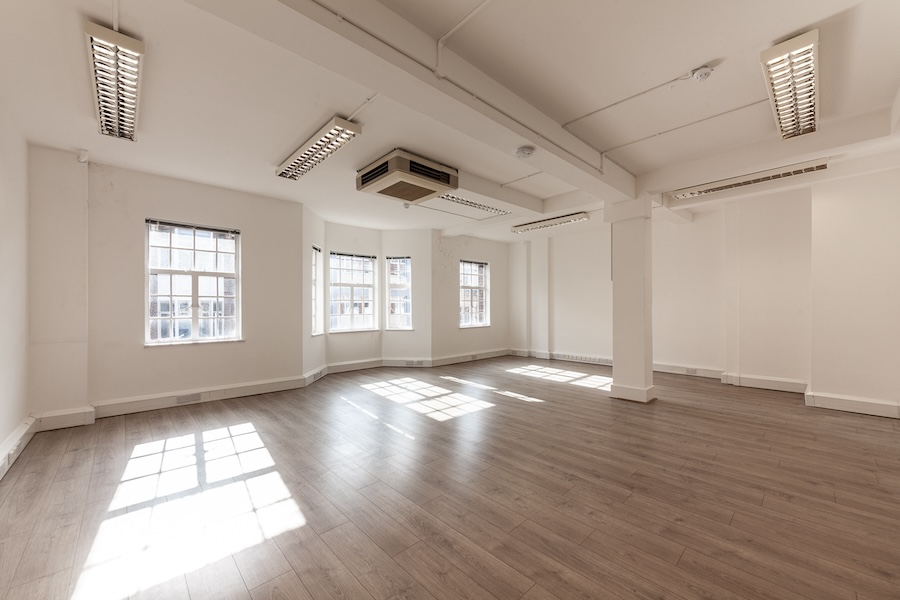
Additional costs are layered on top, making the true overall cost significantly higher than the headline figure suggests. These include:
- Service charge
- Business rates
- Fit-out
- Legal fees
- Potential end-of-term dilapidations
Many of these costs are also front-loaded, meaning a significant amount of capital is required before the space is operational.
Managed offices
Total occupancy costs for managed offices are structured similarly, but with a few key differences. Pricing is less standardised and usually sits above serviced offices on a per-desk basis.
This is because of the larger footprint, greater privacy and higher level of customisation involved—with costs varying depending on the specific space and agreement.
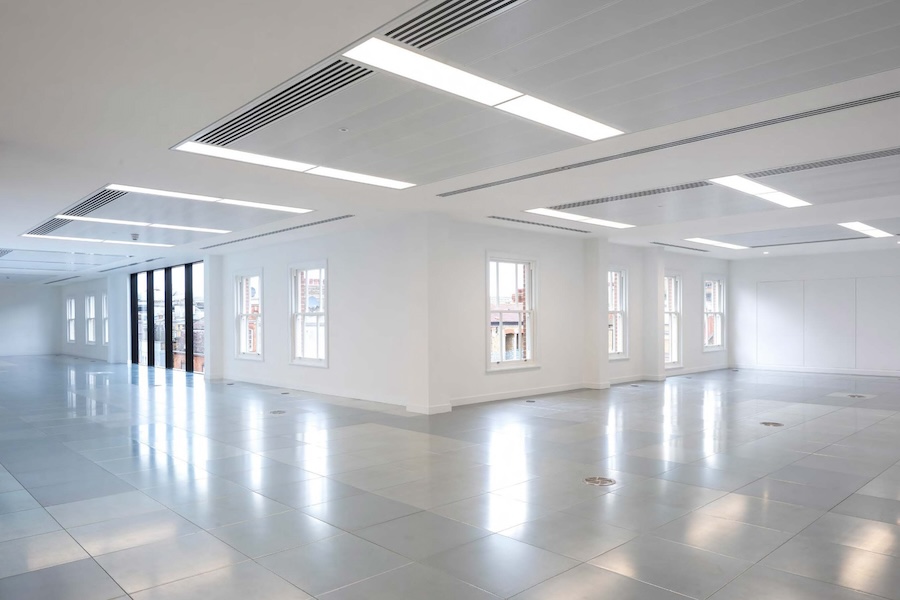
Like serviced offices, most core costs are bundled into a monthly fee, making them easier to predict and reducing upfront spend.
But compared to a traditional lease, this model often comes at a premium over time, as you’re paying for flexibility and for the provider to deliver the fit-out.
For many startups, though, that trade-off can be worthwhile if it helps preserve cash flow and maintain runway.
Serviced offices
Serviced offices are similar. Core costs such as rent, business rates and utilities make up your monthly fee, with additional services (e.g. meeting rooms or add-ons) charged separately.
This makes the headline figure a more reliable guide when budgeting.
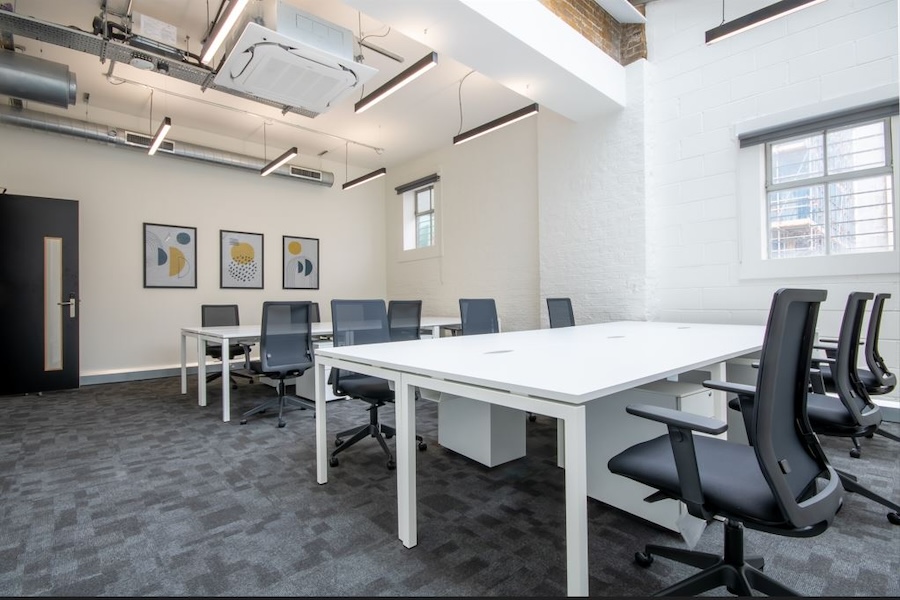
Pricing is usually calculated per desk rather than per square foot. According to Hubble’s Q2 2026 dataset, the average cost to rent a serviced office in London sits around £470–£805 per desk per month, with regional options sitting below that.
TL;DR:
| Serviced Offices | Managed Offices | Leased Offices |
| Costs are typically calculated per desk, per month, often ranging from around £470–£805 in London. Core costs like rent, business rates and utilities are treated as one monthly fee, with some add-ons charged separately. | Managed offices sit above serviced space on a per-desk basis, reflecting the larger footprint and customisation. Costs are typically bundled into a monthly fee, though pricing is bespoke and varies by agreement. | Costs are quoted per square foot and split across rent, service charge, business rates and fit-out. This makes total occupancy cost less predictable and typically requires upfront capital before moving in. |
Get the latest data for full-time and part-time office costs across London
Speed to occupancy
Leased offices
Traditional leases are the slowest route to occupancy. From initial search to move-in, the process typically takes around 3–12 months, depending on the complexity of the deal and the size of your team.
This is largely due to the number of stages involved. Fit-out alone can take one to four months, depending on the project’s scope.
For startups focused on flexible office growth, that delay can directly affect hiring timelines and operational momentum.
Managed offices
Managed offices usually require a short lead time for fit-out and customisation, but are still significantly faster than a lease.
Because the space is customised to your requirements, it still requires a fit-out phase. This typically takes around 4–8 weeks, depending on the level of design and furnishing required.
While slower than serviced offices, this is still considerably faster than a traditional lease, as much of the process is handled by the workspace provider.
Serviced offices
Serviced offices (also called plug-and-play offices in the UK) are designed for speed. Because the space is already fitted, furnished and operational, businesses can often move in within days—sometimes even within 24 hours once terms are agreed.
In practice, the timeline largely depends on how long you take to search and decide. With fewer legal steps and no fit-out required, the process is significantly more streamlined.
Contract structure — Licence vs Lease
Licence
Serviced offices operate on licence agreements, which are shorter, more flexible and easier to exit than leases.
Managed offices are also typically offered under licence-style agreements, although with longer commitments and more defined terms.
Lease
Traditional offices are usually let on full repairing and insuring (FRI) leases, typically for 3 to 10 years, sometimes with break clauses.
Leases are more complex and place greater responsibility on the tenant, including maintenance, compliance and end-of-term dilapidations. They also require legal negotiation before signing.
For startups developing their workspace strategy, this difference is critical. Licence-based models prioritise flexibility and speed, while leases offer greater control—but with longer commitments and reduced agility.
Scaling up and scaling down — how each model handles growth
Expanding headcount mid-term
With serviced offices, scaling up is straightforward. If extra desks or offices are available in the building, you can do so by updating your agreement or moving into a larger space. This can happen within days or even within 24 hours.
Managed offices are more structured but relatively flexible. If your provider has additional space, you can often expand without relocating. But this may involve extending your agreement or taking on adjacent space, with some lead time for reconfiguration or fit-out.
With a traditional lease, expansion is much less flexible. You may need to negotiate a new lease, take on extra space elsewhere, or relocate entirely—all of which take time and legal work.
Contraction and early exit
Serviced offices are the most forgiving when it comes to reducing space. Businesses can either downsize at the end of their licence term or adjust their footprint during the term, depending on the agreement.
Managed offices offer some flexibility, but with more constraints. While providers may allow you to reduce space or renegotiate terms, this is usually subject to notice periods and a commercial agreement.
Leases are the least flexible. Exiting early is often only possible through a break clause, and even then, strict conditions usually apply. If a break isn’t available—or is missed—businesses may need to assign or sublet the space, which can take time and doesn’t remove all liabilities.
In some cases, companies remain responsible for rent, service charge and dilapidations until a new tenant is secured.
Why investors and boards prefer the Opex Model
Flexible workspaces are typically structured as operating expenditure (opex), meaning costs are paid monthly rather than upfront.
That changes how workspace shows up financially. Instead of committing capital to fit-out and taking on a long-term lease liability, costs remain variable and easier to adjust as the business grows.
For investors and boards, this reduces exposure. It preserves cash, keeps the balance sheet lighter and avoids locking the business into commitments that may not reflect future headcount.
Leases work differently. Fit-out costs are usually paid upfront, and the lease itself sits as a long-term obligation. That can limit flexibility from a financial-planning perspective, particularly in the early stages of growth.
That said, this isn’t a blanket preference. For more established businesses with stable headcount, a lease can offer better value over time (particularly once upfront costs are spread across a longer period).
Choosing the right model for your stage
At this stage, the decision comes down to how predictable your growth is—and how much flexibility you need over the next 6–18 months.
- Early-stage startups (5–20 people)
If headcount is still changing and speed matters, serviced offices are usually the most practical option. They let you get set up quickly and adjust as you grow. - Scaling teams (20–100 people)
If you need more space, privacy or branding, but still want flexibility, managed offices offer a strong middle ground. You get a tailored space without locking into a long-term lease. - Established businesses (100+ people)
If your headcount is stable and you can commit long-term, a lease can offer more control and better value over time—provided you’re comfortable with the upfront investment and reduced flexibility.
If you prefer a more visual way to think about it, this quick guide maps out the decision:
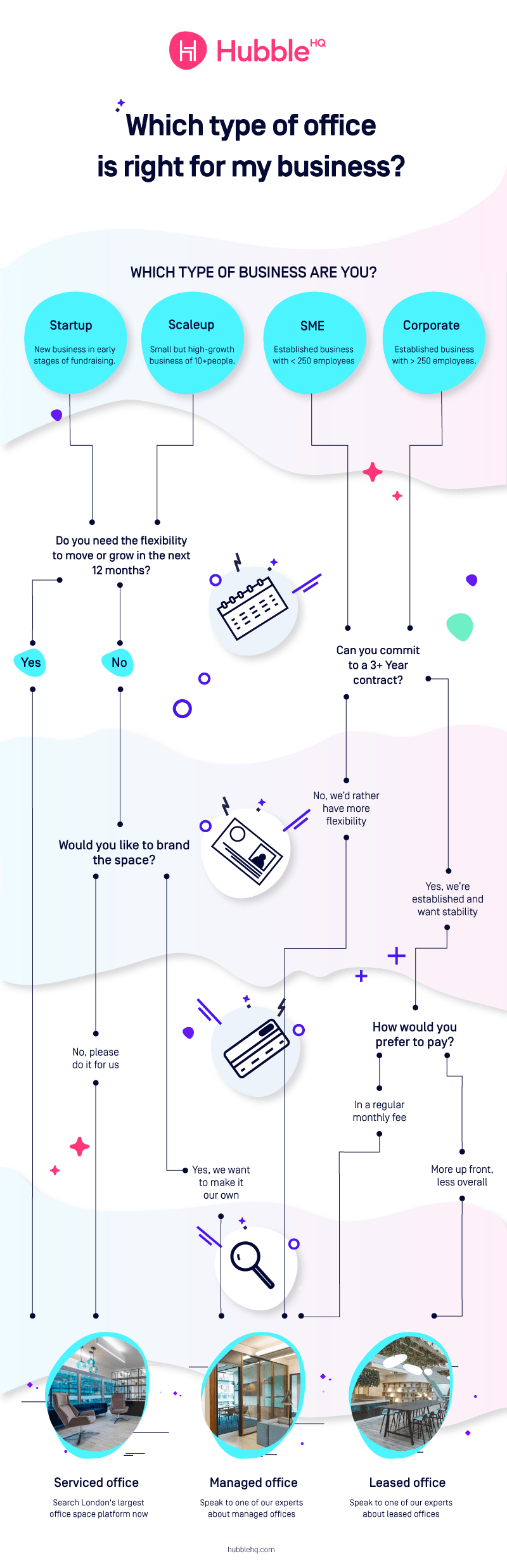
Either way, the right choice comes down to how much certainty you have in your growth plans—and how much flexibility you need.


