
Finding the right office space for rent is no mean feat. There’s a budget to set, a location to pin down and the question of how much space your team actually needs.
But one of the biggest mistakes small businesses make is treating every office search the same. Every workspace model is built for different needs, so understanding the right fit is just as important as setting your budget or choosing a location.
Nowadays, there are three main office models for businesses to weigh up. Should you commit to a traditional office space for lease, opt for a flexible serviced office or choose a shared office space setup instead?
Below, we unpack the key differences between leased, flexible and shared office spaces, so you can shortlist the right model before booking viewings or requesting quotes.
Start with your business constraints
Before comparing office models, it helps to get clear on what your business will realistically need over the next 12 months.
A good place to start is timeframes.
If your team needs to move quickly, a traditional office lease may not be the most practical option. Leasing office space is a much longer process involving negotiations, legal oversight and office fit-out work before you get up and running.
Flexible office providers, on the other hand, can get teams moved in much faster.

Next, think about how stable your team size is likely to be. If your business is expecting to upsize or downsize over the next year, flexibility becomes more important.
For example, a fast-growing team may quickly outgrow a fixed office, while a hybrid team probably won’t want to commit to paying for a space they don’t always use. That’s why businesses with changing headcount prioritise shorter agreements and predictable monthly costs.
However, businesses with more stable headcount may be more comfortable absorbing higher upfront costs, such as legal fees and fit-out, in exchange for lower long-term occupancy costs.

Finally, consider how much creative control you need over the workspace itself.
A traditional office space for lease gives you more say in how the workspace is designed, but also comes with more responsibility. Shared office space and coworking for small businesses are easier to manage day-to-day, although customization options tend to be more limited.
Once you’ve worked through those practical considerations, it becomes much easier to narrow down the right type of office space for your business.
Lease vs flexible vs shared: A quick comparison
| Model | Typical Commitment | Pricing Structure | What’s Included | What Costs Extra | Speed-to-Move | Scalability |
| Traditional leased offices | Multi-year lease term | Rent and operating expenses | Empty or partially fitted office | Utilities, fit-out, furniture, internet, service charge | 3-6 months | Low |
| Flexible/ serviced office | Rolling or short-term agreement | Monthly fee per desk or private office | Utilities, internet, cleaning, workspace management | Additional meeting rooms, extra desks, premium services | 3 days to 2 months | Very high |
| Shared office space | Monthly membership or PAYG | Membership-based pricing | Shared amenities, WiFi, breakout areas | Meeting rooms, storage, guest access | 24 hours | Moderate |
Traditional leased office space
A traditional office space for lease is a good fit for businesses that want greater control over their workspace and have a clear idea of what they’ll need over the next few years.
Unlike flexible office space, you’re responsible for much more than paying the rent.
You hold the keys to the kingdom, so to speak. You’re unlikely to work within a third party’s constraints, and you have much more freedom to design and build the space to your liking.
This includes everything from furniture, internet setup to cleaning, maintenance and fit-out work.
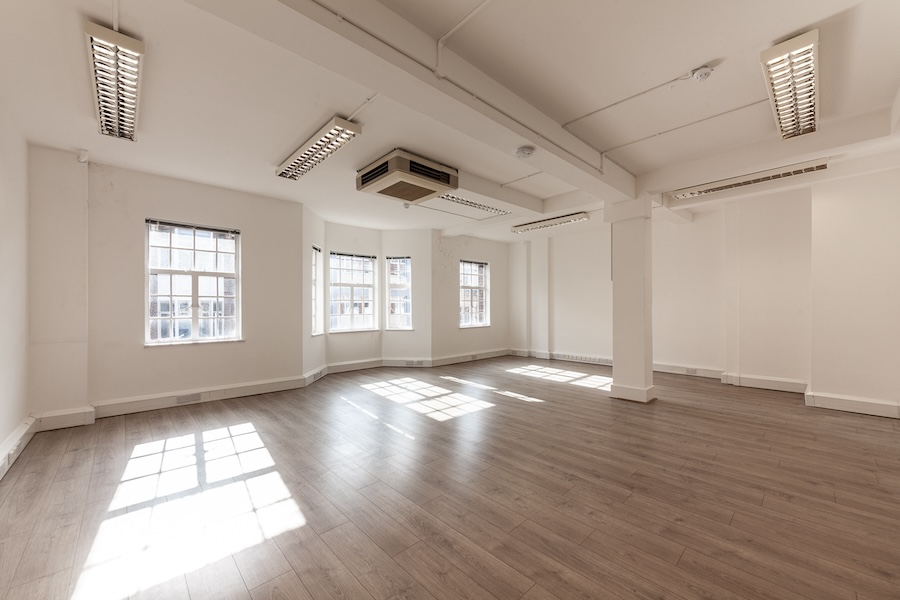
Cost structures are also different. Alongside base rent, businesses will need to budget for operating expenses or service charge costs, utilities, deposits and upfront fit-out spend.
Lease terms are also significantly longer than those of serviced office agreements or shared office memberships, so businesses should think carefully about future headcount plans before committing.
For smaller businesses, this model can offer more control and potentially lower long-term occupancy costs, but it also comes with less flexibility if plans change.
Flexible office space
Flexible office space sits somewhere between a traditional lease and coworking for small business teams.
In most cases, businesses rent a private office within a larger flexible workspace building, like WeWork. These are often referred to as serviced offices.
Unlike a traditional office lease, a serviced office bundles internet, utilities, cleaning, furniture, and workspace management into a single monthly fee.
That makes costs easier to forecast and significantly reduces the operational workload on internal teams.

Speaking of which, pricing is often structured per desk.
For smaller teams, this can make budgeting much simpler, as you’re paying for the people using the space rather than committing to a set amount of square footage and the costs that come with it.
But for us at Hubble, one of the biggest advantages of flexible office space is scalability. Businesses can often add desks, move into larger offices or adjust their setup far more easily than they could under a traditional lease.
That can be particularly useful for growing companies, hybrid teams, or businesses entering new markets where future headcount remains uncertain.
The trade-off is that convenience and flexibility can come at a premium, with monthly costs sometimes working out higher than a traditional lease over the longer term.
Shared office space (Hot desks and dedicated desks)
If flexibility is your top priority, shared office space is often the simplest option—especially if you’re an early-stage business or have a very small team.
Traditionally, this has meant hot-desk and dedicated-desk memberships, where employees work at desks in a shared environment rather than renting a private office.
But more recently, many providers have introduced on-demand workspace access through day passes or monthly access bundles, giving businesses even more flexibility in how, when and where they work.

Pricing is typically membership-based, giving users access to a particular workspace or provider network. However, that’s no longer the only option.
Many businesses now use pay-as-you-go access or monthly workspace bundles, allowing teams to work from different locations as and when needed.
Of course, that flexibility comes with a trade-off. Shared workspace generally offers less privacy, consistency and control than a dedicated private office.
Comparing all-in cost across models
Comparing office costs isn’t always straightforward because each workspace model is priced differently.
For example, a traditional office space for lease is priced per square foot, while serviced offices are priced per desk. Shared office spaces are structured around monthly memberships.
As a result, two options can appear very different on paper, even if the overall cost ends up being similar.
That’s because the headline figure doesn’t always include the same things. With a square-foot rate, you’re measuring the cost of the physical office itself, plus you’ll need to budget separately for service charges, utilities, and fit-out work.
But a per-desk rate often includes services, amenities and workspace management in the monthly rent.
That’s why it’s important to look at the total cost of occupying and running the space, rather than comparing price per square foot and price per desk directly. They’re measuring different things.
“Businesses often ask, ‘How much does a serviced office cost?’ But the better question is, ‘What do we actually need from the space?’
Office pricing works a lot like booking a hotel. You can go anywhere from the equivalent of a bunk in a hostel to a solid three-star that does the job, all the way up to a five-star suite, and the price moves accordingly.
If you want an office that impresses clients the moment they walk in, you’re looking at the five-star end. If you’re after good quality with a few nice touches, that’s your solid mid-range. And if you simply want a workspace that does the job, there are plenty of options there too.
Hubble’s in-house pricing data reflect that range, with flexible office space in London spanning from around £180 to £1,350 per desk per month, depending on location, amenities and workspace quality.” — Tushar Agarwal, CEO and Co-Founder at Hubble
Learn the core price differences for coworking memberships and serviced offices across the UK
Contract and risk considerations
At this stage, you’ve probably got a good idea of how each workspace model differs in terms of cost, flexibility and day-to-day management.
The final consideration is risk.
As we’ve already touched on, traditional leases typically involve longer agreements and greater obligations than flexible office space or shared workspace memberships. Notice periods, guarantees and other contractual commitments are therefore worth paying close attention to before signing.

It’s also worth thinking about where the risk sits if your plans change. With a traditional lease, much of that responsibility falls on you. If headcount changes unexpectedly or the space no longer meets your needs, adapting is more difficult.
Flexible office providers reduce much of this risk, as most of their contracts roll month to month. Sometimes, there’s even a smaller or larger office available in the same building that you can move into with relative ease.
Of course, this doesn’t make one model better than another. The key is understanding how certain you are about future growth plans and choosing a level of commitment that reflects that.
A simple decision framework
If you’re still unsure about which option is right for your business, you can make things easier by answering the following questions:
How much control do you want?
If complete control over layout, branding, and workplace policies is a priority, a traditional office space for lease is likely the best fit.
If you’re happy to work within an existing setup, a serviced office or shared workspace can take a lot of the hassle away!
How much responsibility do you want to take on?
Leased offices give businesses greater freedom, but they also mean managing fit-out projects, suppliers, and day-to-day operations.
Serviced offices and shared office spaces shift much of that responsibility to the workspace operator, allowing teams to focus on running the business.
How much flexibility do you need?
If your headcount or workplace strategy is likely to change, flexible office space gives you more room to scale without committing to a long-term lease.
Established businesses with stable plans may be more comfortable trading some of that flexibility for greater control.
How much do you want included?
If you’re happy to arrange your own fit-out, furniture, internet and day-to-day office management, a traditional office space for lease offers greater control.
If you’d rather move into a workspace that’s already set up and ready to use, a serviced or shared office space can take much of that work off your plate, with facilities and workspace management included in the agreement or membership.
Do you need a permanent office?
Some businesses need a dedicated base for collaboration, client meetings or storing equipment. Others simply need a reliable workspace a few days a week.
If it’s the latter, shared office space (such as on-demand workspace) can provide access to professional offices without committing to a permanent private office.
Checklist before you commit
By this stage, you’ve hopefully narrowed your search down to one or two workspaces. Before signing, it’s worth taking a final step back and checking the practical details.
| Visit the office at a realistic time A workspace that feels calm on a Friday afternoon may have a very different atmosphere on a busy Tuesday morning. |
| Test the day-to-day experience Check the WiFi, phone signal, meeting rooms, breakout areas and anywhere your team is likely to spend time. |
| Ask how the workspace can grow with you Whether you’re considering an office space for lease, a serviced office or shared office space, it’s worth understanding how easy it is to add desks, move offices or change your agreement if plans evolve. |
| Confirm exactly what’s included Make sure you understand what’s covered by the monthly rent or membership fee, along with any additional charges for meeting rooms, guest access or other services. |
| Look beyond the office itself Transport links, nearby cafés, gyms and places for informal meetings can have just as much impact on the day-to-day experience as the workspace itself. |
How Hubble can help
Once you’ve decided which workspace model is right for your business, the next step is finding office space for rent that fits your needs.
If you prefer to search independently, Hubble’s flexible workspace platform lets you browse real-time office listings with transparent pricing and detailed information, making it easier to compare options and build a shortlist.
If you’d rather have some expert guidance, our Tenant Advisors can recommend suitable spaces, negotiate the best rate and help you navigate the search from start to finish, all completely free.
For businesses that don’t need a permanent office, Hubble On-Demand provides access to coworking spaces, private day offices and meeting rooms through pay-as-you-go access or monthly workspace bundles, so teams can work from different locations whenever they need to.



